


 Lab-grown · IGI
THE DIAMOND STUDIO
Hexagon Diamonds
Six straight sides give a hexagon diamond a crisp, architectural look. Read more
Classic shapes
Antique & distinctive shapes
Refine your search
Lab-grown · IGI
 Lab-grown · IGI
1.33 ct Hexagon
D · VS1 · Excellent$879.00 Lab-grown · IGI
2.05 ct Hexagon
D · VVS1 · Excellent$2,399.00 Lab-grown · IGI
6.29 ct Hexagon
E · VS1 · Excellent$8,959.00 Lab-grown · IGI
6.53 ct Hexagon
E · VVS2 · Excellent$11,199.00 Lab-grown · IGI
6.36 ct Hexagon
E · VVS2 · Very Good$9,529.00
The shape
About Hexagon Diamonds
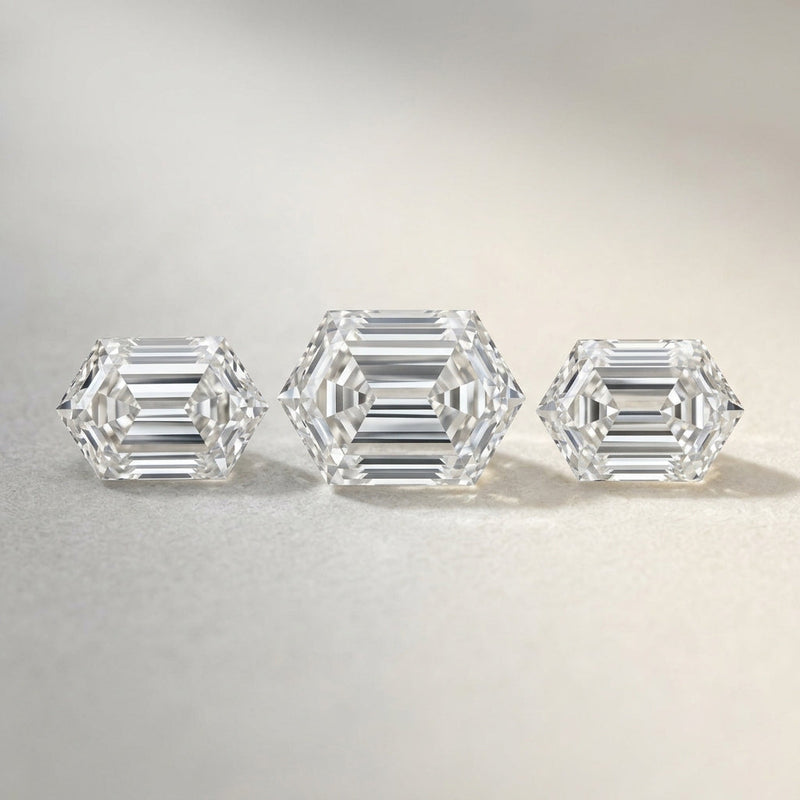
Six straight sides give a hexagon diamond a crisp, architectural look. It can be cut with equal sides or stretched into a longer, elongated hexagon, and many are step cut, with long parallel facets that give broad flashes of light.
The geometry is associated with Art Deco design but suits a modern, minimal ring just as well. A lab-grown hexagon is an easy way to make a classic solitaire feel new.
Side by side
Hexagon vs Emerald diamonds
 This page  Hexagon |
 Emerald |
|
|---|---|---|
| Outline | Six sides, equal or elongated | Rectangle with cut corners |
| Cut style | Often step cut | Step cut: long parallel facets |
| Sparkle | Broad flashes of light | Hall-of-mirrors flashes |
| Size for its carat | Elongated hexagons can look larger for their carat | Looks larger than a round of the same carat |
| Settings that suit it | Bezel, or six prongs on the corners | Solitaire, three-stone, east-west |
| Diamonds available | 558 | 625 |
Hexagon diamond questions
Regular or elongated hexagon?
A regular hexagon, with equal sides, looks compact and honeycomb-like. An elongated hexagon looks longer on the finger and closer to an emerald cut with pointed ends.
Hexagon or emerald cut?
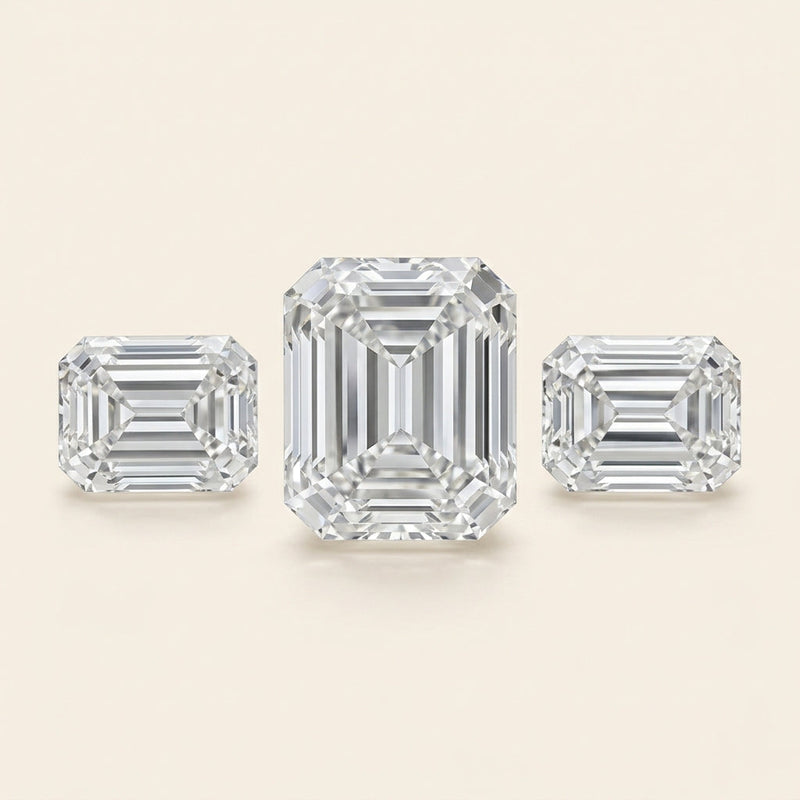
An emerald cut has eight sides, a rectangle with clipped corners. A hexagon has six, with an angled point at each end, so it reads sharper and more geometric.
Which bands suit a hexagon diamond?
Straight, plain bands echo its clean lines, and a bezel that follows all six sides gives it a crisp frame. Six prongs, one at each corner, show more of the stone.