


 Lab-grown · IGI
THE DIAMOND STUDIO
Kite Diamonds
Pointed at one end and broad at the other, a kite cut diamond has built-in direction. Read more
Classic shapes
Antique & distinctive shapes
Refine your search


The shape
About Kite Diamonds
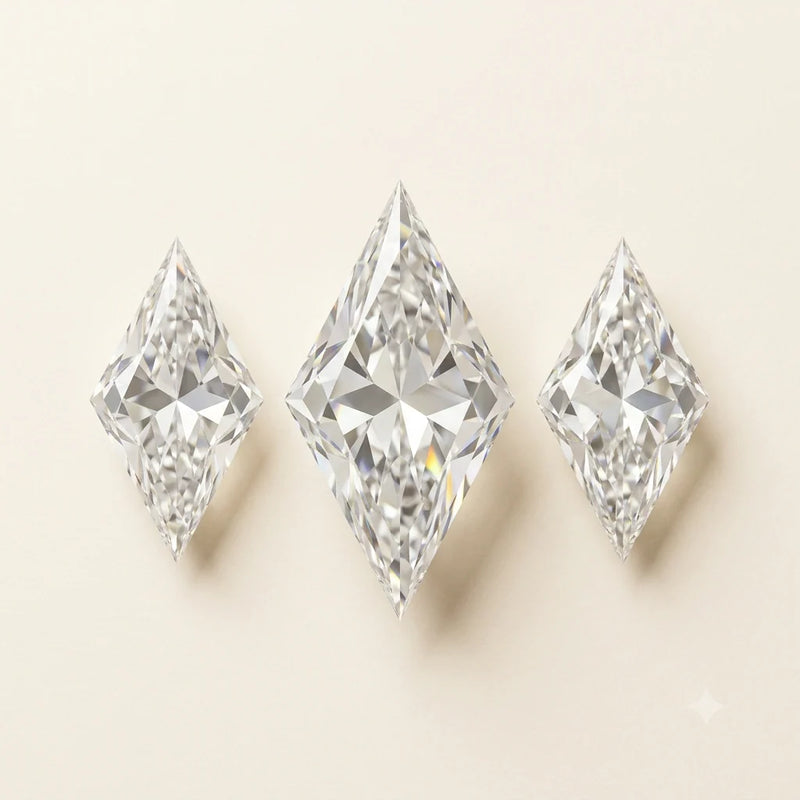
Pointed at one end and broad at the other, a kite cut diamond has built-in direction. Two short sides meet at a wide top and two long sides taper to a point, a clean geometry associated with Art Deco design and cut today in both step and brilliant styles.
A kite can stand alone as an angular center stone or sit in pairs as side stones pointing toward a center. Our lab-grown kites are a favorite for unconventional rings and modern stacks.
Side by side
Kite vs Lozenge diamonds
 This page  Kite |
 Lozenge |
|
|---|---|---|
| Outline | Four sides: broad top, long point below | Four equal sides, two sharp points |
| Cut style | Step or brilliant | Often step cut |
| Sparkle | Clean, graphic flashes | Broad, mirror-like flashes |
| Size for its carat | Many look larger than a round of the same carat | Its length helps it look larger |
| Settings that suit it | V-prong or bezel cap on the point | Bezel, or V-prongs on both points |
| Diamonds available | 171 | 174 |
Kite cut diamond questions
How are kite diamonds used as side stones?
Two kites set point-inward on either side of a center stone frame it and draw the eye toward it, a classic Art Deco arrangement.
Kite or lozenge: what is the difference?
A lozenge has four equal sides and is symmetrical end to end. A kite has two short and two long sides, so it is broad at one end and pointed at the other.
Step cut or brilliant kite?
A step-cut kite shows calm, mirror-like flashes and a crisp outline. A brilliant kite sparkles more. The video on each diamond's page shows which style it is.