Bow Tie
Bow Tie Diamond: Reading the Shadow in Ovals, Pears and Marquise
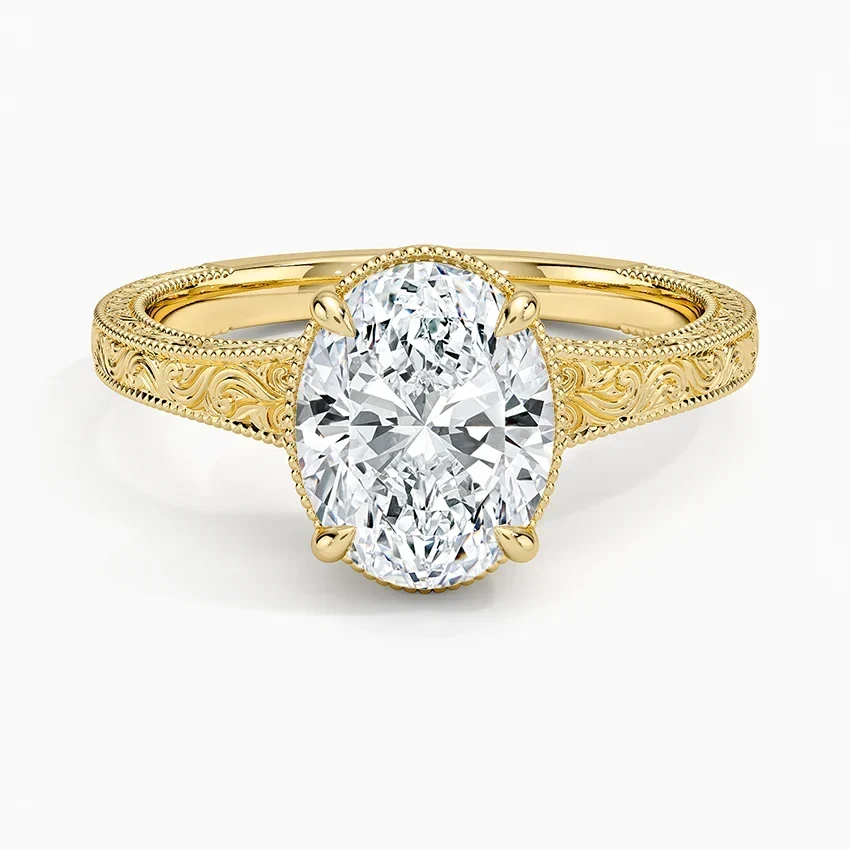
Hold an oval diamond face up under a lamp and look straight down at it. In a great many stones you will see a darker band running across the middle, wide at both edges and pinched in the center. Jewelers call it the bow tie, and a stone that shows one strongly is often called a bow tie diamond. It is not an inclusion and it is not a defect in the material. It is a shadow, and it comes from the shape.
If you are drawn to elongated diamonds, this is the one thing most worth learning to see, because nothing on paper will see it for you.
What Causes a Bow Tie in a Diamond
A round brilliant is symmetrical in every direction. Its facets are angled so that light entering through the top bounces off the pavilion, the lower half of the stone, and comes back up toward your eye from nearly every point.
Ovals, pears and marquise diamonds are brilliant cuts too, only stretched. Along the long axis the pavilion facets have room to do their work. Across the narrow middle the cutter has to bend those angles to fit the outline, and some of the light that should return through the top escapes out the bottom instead. Your own head, leaning over the stone, blocks a little more. What you see is a dark zone across the width.
Almost every elongated brilliant has one. The useful question is never whether it is there. It is how dark it is, how wide it is, and whether it moves.
Why the Grading Report Stays Silent
A grading report records color, clarity, carat weight, measurements, polish and symmetry. For fancy shapes it usually stops short of an overall cut grade, and the bow tie is not something a report describes.
So two ovals with nearly identical paperwork can look very different on a hand. One shows a faint gray flicker that vanishes the moment it tilts. The other carries a band that stays put whatever you do. The difference is the cutting, and you can only judge it by looking.
How to Judge a Bow Tie Diamond in Person
- Watch it move. A bow tie that shifts between light and dark as the stone rocks is the shape at work. A band that stays dark from every angle is light leaving the stone.
- Look from the distance you will actually see it, roughly the distance from your eye to your hand, not through a loupe.
- Change the light. Soft daylight near a window is honest. A ceiling full of spotlights flatters almost anything.
- Compare in pairs. The eye is poor at judging contrast in a single stone and very good at judging it between two.
- Ask for video. If you are choosing remotely, a slow rotation tells you more than any still photograph.
The Bow Tie in Oval, Pear and Marquise Diamonds

The oval is the gentlest of the three. Its curves are soft, so a well cut oval tends to show a light bow tie that comes and goes. The setting matters too. On the Tapered Calla Engraved Solitaire, claw prongs hold the oval and keep the setting open to light from every angle, so the stone's contrast reads honestly rather than through a wall of metal.

The pear has a rounded end and a point, and its shadow usually gathers across the widest part of the body. Look for shoulders that are full and gently curved rather than flat. Flat shoulders make a pear look thin and tend to deepen the dark zone. In the Petite Cantata three stone ring, two pear-shaped side stones flank an oval center in a low basket that leaves the sides open to light. At that scale the pears read as bright points, and the bow tie question belongs to the center.

The marquise is the most demanding. It is long, narrow and pointed at both ends, which leaves the least room across the middle, so its bow tie is often the strongest of the three. A marquise with a bright, lively center is worth the patience it takes to find. The Vintage Marquise ring sets one as a solitaire with fine hand-engraved detailing along the band, which keeps the attention on the stone's long outline.
Ratio Comes First, Then the Shadow
Length to width ratio is how long a stone is compared with how wide. It decides the character of the shape: a short, full oval or a long, slender one. Choose that by eye on your own hand first, because it is a matter of taste. We wrote more about how measurements change what you see in Diamond Carat vs. Size. Then, within the ratio you like, judge the bow tie stone by stone.
Our View
Do not chase a stone with no bow tie at all. A little contrast across the center is part of what makes an elongated diamond look alive rather than glassy. What you want is a shadow that moves, never one that sits.
Questions People Ask
Is a bow tie in a diamond bad?
Not by itself. Almost every oval, pear and marquise shows some bow tie, because the shadow comes from the elongated shape rather than from a flaw. What matters is how dark and wide it is. A faint band that shifts as the stone moves is normal. A heavy band that never changes is worth avoiding.
Do round diamonds have a bow tie?
A well cut round brilliant does not show a true bow tie. Its facets are arranged symmetrically in every direction, so light returns evenly across the whole face. The effect belongs to elongated brilliant cuts, where the narrow middle leaves less room for the facets to send light back toward your eye.
Can you see a bow tie on a diamond grading report?
No. A grading report records measurements, color, clarity, carat weight, polish and symmetry, but it does not describe the bow tie. Two stones with nearly identical reports can look quite different on a hand. The only reliable way to judge it is to see the stone move, in person or on video.
Which diamond shape has the strongest bow tie?
The marquise usually shows the strongest, because it is long, narrow and pointed at both ends, which leaves the least room across the middle. The pear comes next, with its shadow gathering across the widest part of the body. The oval, with its soft curves, tends to show the lightest bow tie of the three.
Look closely, and trust what you see on your own hand.
In a Dutch marquise diamond, broad antique facets often make the bow tie read as character rather than a flaw.
Questions? Write to us at info@thejewelrystudio.us.