Cushion Cut
Elongated Cushion Cut Diamond: Ratios, Looks and Settings
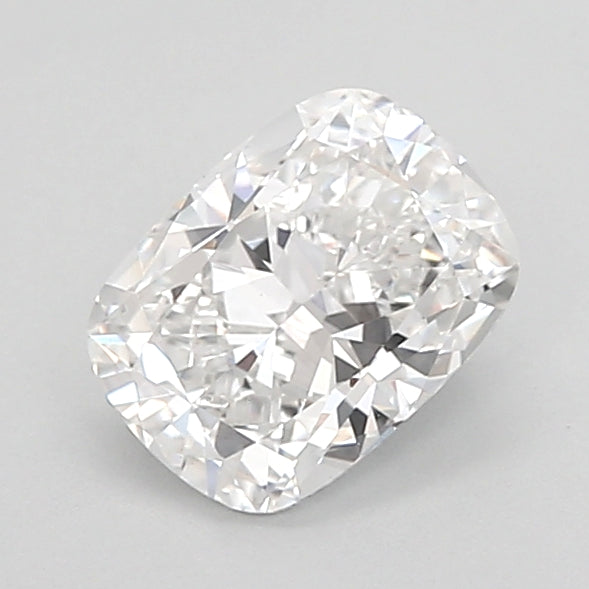
An elongated cushion cut diamond is a cushion with a rectangular outline: rounded corners, softly curved sides and a length clearly greater than its width, generally a length-to-width ratio of about 1.15 or more. It keeps the cushion's pillow softness but reads longer on the finger, closer to an oval in presence.
The square cushion has been a staple for a long time. The longer version is the one people are asking about now, and it deserves its own explanation, because a change in outline changes nearly everything about how the stone wears.
What Makes a Cushion Elongated
Every diamond shape can be described by dividing its length by its width. A perfectly square cushion measures 1.00. Most cushions sold as square sit a little above that, up to roughly 1.05 or 1.08, where the eye still reads them as square.
Past about 1.10, the stone starts to look rectangular. Between roughly 1.15 and 1.25 it reads as gently elongated. Around 1.30 and beyond, the outline is plainly a long rectangle with soft corners, and that is the look most people mean when they search for an elongated cushion.

Here is a real example. Our 1.00 carat cushion lab-grown diamond measures 7.05 by 5.21 mm, according to its listing. Divide one by the other and you get a ratio of about 1.35: clearly elongated, without tipping into a slim bar. It is D color and VVS2 clarity.
Elongated Cushion vs Square Cushion
The two share a family resemblance and very little else once they are on the hand.
A square cushion is compact and symmetrical. It looks the same whichever way it turns and sits as a neat block of light. Cushions are often cut with generous depth, so a square one can look a little smaller face up than its carat weight suggests.
An elongated cushion spreads its weight over a longer outline. On the finger, length reads as size, so an elongated stone usually looks larger face up than a square one of the same carat weight. It also draws the line of the finger out, which many people find flattering.
Elongated Cushion Cut vs Oval
This is the comparison most shoppers are really making. Both are long, soft-edged shapes. The difference sits in the corners.
An oval is a continuous curve with no corners at all. An elongated cushion keeps four rounded corners and sides that are only gently bowed, so it looks more architectural: a rectangle softened, rather than an ellipse. Side by side, the oval looks fluid and the cushion looks tailored.
Both can show a bow tie, the dark band across the middle that appears in many elongated brilliant shapes. It comes from the cutting, it varies from stone to stone, and it is worth checking in video before you choose. Our guide to the bow tie in ovals, pears and marquise explains how to read it.
How the Elongated Cushion Compares With Its Neighbors
- Elongated cushion: a rounded rectangle with gently curved sides. Usually a brilliant facet pattern with soft, bright sparkle. Best in four-prong solitaires, east-west settings and hidden halos.
- Square cushion: the same pillow shape at a ratio near 1.00. A compact, even sparkle. Best in classic solitaires and halos.
- Oval: a smooth ellipse with no corners. Very lively, sometimes with a bow tie. Suits almost any setting.
- Radiant: a rectangle with cut corners and straighter sides. Intense, busy brilliance. Best in prongs that guard the corners.
- Elongated old mine or antique cushion: a long cushion outline with a tall crown, small table and broad facets. Slower, larger flashes. Best in simple claws or a collet.
Crushed Ice or Chunky: Reading the Facets
Cushion describes an outline, not a single facet plan, and two elongated cushions can look very different face up.
Many modern cushions use extra facets on the pavilion that break light into small, scattered points. People call it a crushed ice look. Others use larger facets in a pattern closer to the older cutting style, which gives bigger, more distinct flashes. Neither is better. The crushed ice style feels glittery and modern; the larger pattern feels calmer and a little vintage.
If what you love is the antique version, with a tall crown and a small table, you are really looking at an old mine cut. We covered that in our old mine cut guide, and the sideways antique look in our piece on the east-west antique cushion.
Choosing a Ratio for an Elongated Cushion Cut Diamond
There is no correct number, only the look you want. A few honest guidelines:
- Around 1.10 to 1.20: a soft rectangle that still feels close to the classic cushion.
- Around 1.20 to 1.35: clearly elongated, the range most people picture.
- Above 1.40: a long, slender outline that reads almost like an antique bar. Striking, though it can look narrow at a small carat weight.
Look at the measurements, not only the label. Two stones both described as elongated can sit far apart on this scale.
Settings That Suit a Long Cushion


An elongated cushion works north-south, with its length running along the finger, or turned sideways. The Sutton East-West solitaire turns the center stone sideways, with a bezel framing it and decorative prongs wrapping its edge, and it takes a cushion center from 0.50 to 4.00 ct. For a north-south look with an open, sculptural band, the Meridian Solitaire holds the center in compass-style claw prongs on a bypass band, and it also takes cushions from 0.50 to 4.00 ct.
Whatever the setting, the corners matter most. Claws placed at or near them follow the outline and keep those softly rounded edges protected.
Questions People Ask
What ratio is an elongated cushion cut diamond?
An elongated cushion generally has a length-to-width ratio of about 1.15 or higher. Stones from roughly 1.20 to 1.35 read as clearly rectangular, while those near 1.00 to 1.08 read as square. Always check the measurements rather than the label, since the word elongated is used loosely across the trade.
Does an elongated cushion look bigger than a square cushion?
Usually, yes. At the same carat weight, an elongated cushion spreads across a longer outline, and length reads as size on the hand. A square cushion concentrates its weight in a compact shape, so it can look smaller face up. Depth matters too, so compare measured length and width, not just carats.
Is an elongated cushion the same as an oval?
No. Both are long and soft-edged, but an oval is a continuous curve with no corners, while an elongated cushion keeps four rounded corners and gently curved sides. The cushion looks more tailored and structured; the oval looks more fluid. Both can show a bow tie, so view either shape in video before deciding.
Which setting is best for an elongated cushion?
A four-prong solitaire with claws near the corners is the classic choice, because it follows the outline and shows the stone's length. East-west settings, which turn the stone sideways, give it a more modern line. Bezels suit an active life. A hidden halo adds sparkle from the side without changing the outline face up.
An elongated cushion is a quiet kind of statement: familiar in its softness, modern in its line. Take your time with the ratio, because that one number decides the look.
Questions? Write to us at info@thejewelrystudio.us.