Ring Stacking
Curved Wedding Band: When a Contour Beats a Straight Band
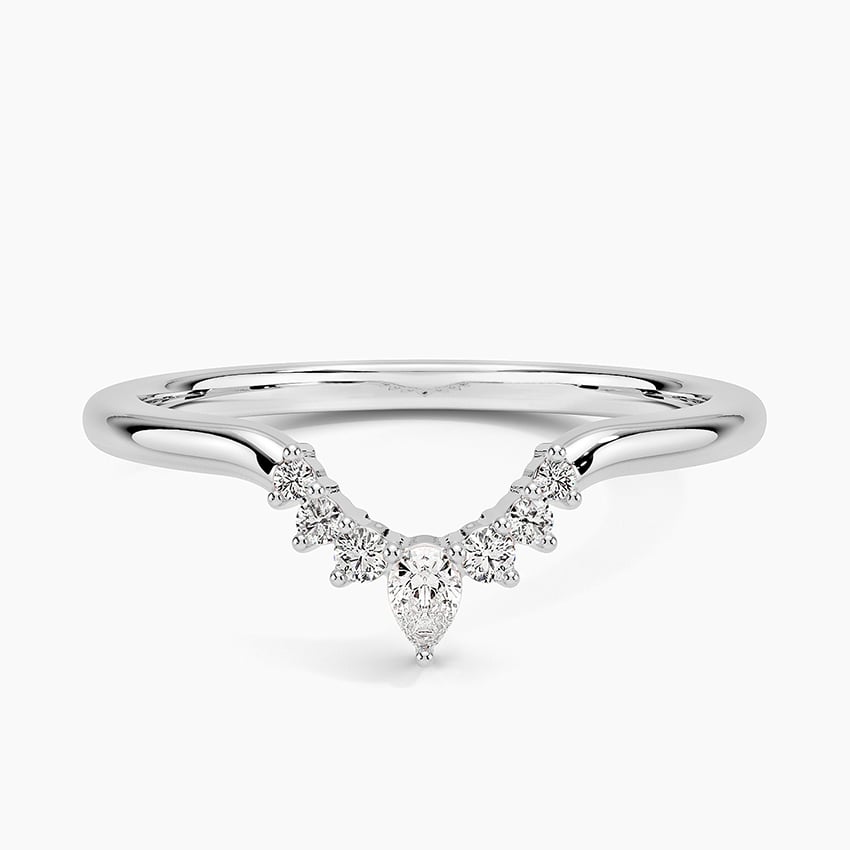
A curved wedding band is a band shaped to bend around something, almost always the center stone of an engagement ring. Where a straight band runs flat and accepts whatever gap the engagement ring leaves, a curved one dips, arcs or notches so the two rings can sit close. It sounds like a small decision. On the hand, it changes the whole silhouette.
Here is how we think about curved bands: when they earn their place, when a straight band is the better call, and how to look at your own ring before you decide.
Why a Gap Appears in the First Place
Most engagement ring settings hold the center stone above the band. A basket, a halo, a gallery or a pair of side stones all take up room, and many of them sit wider than the band itself. Put a straight wedding band beside that ring and it touches the engagement ring at the back of the finger but stops short at the front, held off by the head of the setting.
That space is the gap. Some people love it. It gives each ring its own outline and lets light move around both. Others find it reads as a mismatch, or notice the two rings drifting and turning against each other through the day. Neither reaction is wrong. The point is to know which one is yours before you choose a band.
When a Curved Wedding Band Makes Sense
A curve is worth it when the engagement ring has something wide at the front that a straight band cannot get past. Three-stone settings, halos and anything with side diamonds tend to fall in this group. So does a pear or marquise center, where a point or a long side reaches past the line of the band.

Our Halfmoon is built for exactly this. It is a 1.5 mm band that dips softly at the center to sit close to an engagement ring, with six round lab-grown diamonds and a pear-shaped center diamond following the curve in shared prongs. The pear sits at the low point of the dip, which is a large part of why the pairing looks intended rather than adjusted.

The Yvette Curved takes a slightly different route. It follows a gentle curve set with four marquise and three round lab-grown diamonds, made to sit close beside an engagement ring. Marquise shapes are long and pointed, so along a curve they read as movement, almost like a spray of leaves bending around the center stone.

For a lighter touch, the Gleam is a 1.4 mm curved band with 23 round lab-grown diamonds in scalloped pavé. Its curve is gentle by design, so it sits neatly beside many engagement ring styles rather than just one.
When a Straight Band Is the Better Call
A curved band commits you to one engagement ring. That is the honest trade. Worn alone, a contour band has a dip with nothing in it, and some people mind that while others never notice. If you expect to wear the wedding band by itself often, at the gym, while traveling, on days the engagement ring stays home, look hard at how the curve reads without its partner.
A straight band also wins when the engagement ring already sits low. A bezel solitaire on a flat band, or a low basket with no side stones, often lets a straight band slide right up against it with no gap at all. In that case a curve solves a problem you do not have.
And some people simply prefer two parallel lines. There is a cleanness to it that no contour can give you.
Curved, Contour or Notched: The Band Shapes to Know
The terms get used loosely, so it helps to sort them by what the band actually does.
- Curved or arc bands bend in one smooth sweep. They suit round, oval and cushion centers and look soft on the hand.
- Chevron or V bands come to a point. They frame the center stone like a crown and suit pears, marquise shapes and anything with a pointed outline.
- Notched bands keep a mostly straight line with a small cutout at the center. They are the least visible of the three and the closest to a straight band in look.
How to Test a Contour Wedding Band Against Your Ring
Look at your engagement ring from the side, at eye level. Notice how far the setting reaches toward where a second ring would sit, and how low the lowest point of the head comes. That profile is what a curved band has to match.
Then look from above with your hand flat. Ask whether you want the two rings to read as one piece or two. If one, you want contact along the full length, and a curve is usually the way to get it. If two, a straight band with a small, even gap may be exactly right.
Metal is the last check. Two rings in the same metal and karat will look alike side by side for years. If you are weighing your options, our guide to 14K vs 18K gold and platinum covers how each one behaves.
Questions People Ask
Do you need a curved wedding band?
Only if your engagement ring leaves a gap you would rather close. Settings with side stones, halos or a pear or marquise center often stop a straight band from sitting flush. A low bezel or low basket solitaire usually does not, so a straight band will sit right against it.
Can you wear a curved wedding band on its own?
Yes, and many people do. The dip at the center will show when the engagement ring is off, so look at the band alone before you choose. Gentle arcs read as a design choice by themselves. Deep notches and sharp chevrons tend to look like they are waiting for their partner.
What is the difference between a curved and a contour wedding band?
The two terms are often used as one. In practice, curved usually means a smooth arc, while contour can mean any band shaped to follow an engagement ring, including notched and V shapes. The useful question is not the name but whether the shape matches the profile of your setting.
Should a curved wedding band match the engagement ring metal?
Matching metal and karat is the simplest choice, because the two rings sit against each other all day. Mixing can look deliberate when the contrast is clear, such as white gold beside yellow. Avoid two near-identical shades side by side, which tends to look like a mistake rather than a choice.
The right band is the one that makes your engagement ring look finished. Sometimes that takes a curve. Sometimes it takes nothing at all.
Questions? Write to us at info@thejewelrystudio.us.